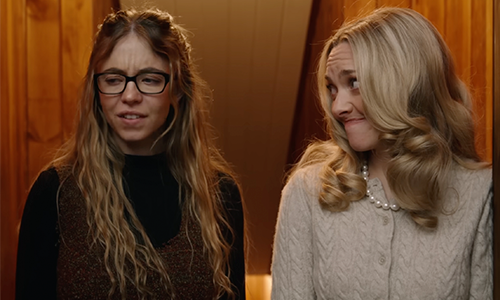
It’s been hotly anticipated, but the book-to-screen adaptation of Freida McFadden’s The Housemaid is finally out in the UK, and you can head to Cineworld now to be completely gripped by the latest thriller starring Sydney Sweeney, Amanda Seyfried, and Brandon Skelnar.
As with any book-to-screen adaptation, there’s always going to be a little bit of creative licence and tweaks in order to translate from the page to the screen. Whether or not you were a fan of the book first, we’ve curated a handy list of all the key differences in The Handmaid between the film and the book.
Spoiler alert: If you've yet to watch the film or read the book and wish to enjoy either without spoilers, please avert your eyes now. The following article will contain spoilers from both the book and film.
1. Nina Winchester doesn’t put weight on in order to repel her husband
In Freida McFadden’s 2022 novel, The Housemaid, Nina Winchester’s character is described as being a US size 14, which equates to around a size 18 in the UK. Once slimmer, in the book it is observed that there are a number of photos around the house that shows as she gained weight over the years, revealed to be a tactic in order to be less appealing to her husband, Andrew. She also neglects to touch up her dark roots.
Of course, Amanda Seyfried is a very petite woman, so this aspect of her physical character is not included in the film, though they did still opt to have her dark roots growing out.
2. Nina confides in Enzo rather than a friend about Andrew’s actions
Enzo has his moment, but it’s not until a little later in the book, with Nina actually confiding in a friend about the things Andrew has done to her. Her friend, clearly not with Nina’s best interests at heart, calls Andrew to tell him what she’s heard, with Nina ending up back in the psych clinic.
This leads Nina to isolate herself and not confide in anyone about her experiences – until she finally tells Enzo. In the film, however, she goes straight to Enzo, who doesn’t question the validity of her story. They hatch a plan to escape, but get found out. Enter Millie, who Nina hires in an endeavour to finally bring Andrew down.
3. Enzo has less of a central role in the film
We find out a lot about Enzo and his background in the book. He speaks Italian in order to deter women in the neighbourhood who fancy him from bothering him, and is later there for Nina to turn to in her time of need. It is then that he shares that his own sister was murdered back in Italy by her husband, and that he’s never been able to forgive himself for allowing it to happen to her. It certainly gives him a motive, then, to want to stop Andrew.
What starts as a friendship deepens into romantic feelings between Nina and Andrew, which is eventually revealed as the reason he rejects Millie’s own advances. When Nina gets away and goes to Enzo’s home, they sleep together, and Enzo is the one to tell Nina to check on Millie, who has been left in the house with Andrew.
Enzo is a less central character in the film. While he does try to help Nina escape when she confides in him, when she is sent back to the psych ward he takes a step back and chooses to remain nearby as support, but doesn’t play an active role in Nina’s life. When it comes to checking on Millie, then, it is Nina’s daughter, Cecilia, who suggest she go back to the house.
4. Cecelia is less bothered about impressing her father
In the film, Cecelia is characterised as wearing inappropriate clothes and being quite cautious around her father, Andrew, aware that when her mother misbehaves she disappears. She is then quite absent, away on camp, when the relationship between Andrew and Millie begins.
Rejoice, though! We get more of Cecelia in the film, who is a lot more sassy and strongwilled – which we love to see. She gets picked up by Nina when she escapes home, who tells her they’re free and can go somewhere new and exciting. However, Cecelia insists she has to check on Millie first, replacing Enzo as the person to send Nina back to the Winchester house.
5. The reason Millie is locked in the attic by Andrew is different
It perhaps doesn’t seem a bad enough crime for Millie to have left some books lying on the table to warrant Andrew’s wrath. That’s why in the film it’s changed to Millie accidentally breaking a plate that holds sentimental value to Andrew as it was his mothers.
The punishment remains the same, though. Millie is locked in the attic. Instead of having to put heavy books on her stomach that leave her black and bruised, though, she instead is made to cut her stomach using the sharp pieces of the broken plate.
6. There’s a tooth or two difference in Andrew’s punishment
As the roles reverse, Millie puts Andrew through a lot. In the book, it’s described as she forces Andrew to pull out multiple of his own teeth, depriving him of water, and leaving him in the attic for days. In the film, however, she’s a little more easy going, only requesting he extract one tooth – and he does end up escaping from the room.
7. Andrew’s cause of death is a lot more dramatic in the film
While Andrew is left, locked away in the attic, for days on end with no water or food, later found by the police who determine he died of dehydration, the film has a far more dramatic climax. Equally, his cause of death could be far more easily shrugged off as an accident in the film than in the book.
Nina comes back to check on Millie. She hears noise from the TV room and assumes this is Andrew, sneaking up the stairs to free Millie, only to discover it is Andrew who has been locked away. Millie is too late to stop her as Andrew bursts through the door and throws Nina down the stairs. She manages to get up unscathed, heading to the landing where Andrew attempts to plead for forgiveness and convince Nina they can work things out.
When Nina tells him no, he goes to attack her again. Millie, who had disappeared, returns and runs at Andrew, pushing him down the stairs where he falls to his death.
8. The identity of the detective is different – but still has a link to Andrew
No matter which way Andrew died – book or film – it’s all pretty suspicious that you’d think both women would be ending up behind bars. But no. As with any horrendous character like Andrew, neither Millie nor Nina were the first women he abused. In the book, the detective that turns up to investigate Andrew’s death turns out to be the father of Andrew’s fiancée who mysteriously went missing.
In the film, it’s still keeping it in the family, but a lot more girlboss. The detective who turns up is a young woman whose sister Andrew was engaged to. Considering his victims are all women, there is something especially satisfying about him finally getting what was coming to him by a force of badass ladies.
9. There are small differences in Nina’s interaction with Andrew’s mother at his funeral
In both the book and film there’s a subtle suggestion that Andrew was unkind to his mother, too – or, at the least, that she was aware of his treatment of women. In the book, Andrew’s parents come up to Nina once all the guests have left. His father is beside himself, giving his condolences to Nina before rushing out of the building. Left alone, Andrew’s mother says she heard about Andrew’s missing teeth. Nina is momentarily panicked, before his mother says that teeth are a privilege and he should have taken better care of them.
Before departing, she thanks Nina for teaching him a lesson and leaves. Nina then takes Cecelia home, with Millie seemingly absent from the scene.
In the film, there is a slight difference in that the interaction happens while both Nina and Andrew’s parents are receiving condolences from mourners. There is an audience, then, when his mother notes his missing tooth, and says similarly that it’s a privilege to have them and he should’ve taken better care. The guests are confused and quickly move on.
The film ends with Nina walking away from Andrew’s parents, over to Millie who is standing with Cecelia at the funeral. They say their goodbyes and part ways.
The Housemaid is out now at Cineworld. Book your tickets below.





.png)





.jpg)
.png)